


Choosing bedsheets should be simple, and somehow it never is. Look up TENCEL™ vs bamboo vs cotton sheets and you will find the same handful of words on all of them. Soft as a feather. Smooth as glass. And here is the thing, they may all be right. Smooth is not one property, which is why three brands can each claim it honestly while describing three different sensations.
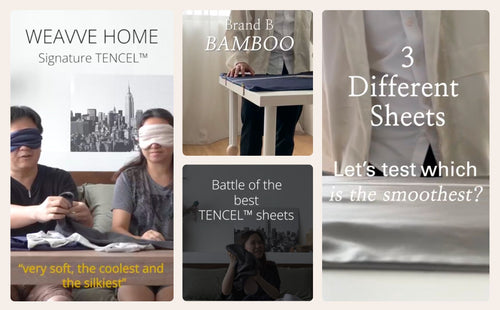
So we ran the comparison ourselves. Across two tests on TENCEL™ vs bamboo vs cotton sheets, our Signature TENCEL™ Bedsheets came out smoothest on both the timed measure and the blind human one. The more useful finding is why, and what it tells you about which sheet you actually want.
Comparing TENCEL™ vs Bamboo vs Cotton
All three of these are plant based cellulose fibres, which surprises people. The differences come less from the plant than from what happens to it afterwards. That processing is what decides how the sheet feels, how it handles moisture, and how long it lasts.
At a glance
|
|
TENCEL™ Lyocell |
Bamboo viscose |
Cotton (extra long staple) |
|
Made from |
Wood pulp, closed loop process |
Bamboo, chemically regenerated |
Cotton fibre, spun and woven |
|
Feels like |
Silky, cool, smooth glide |
Soft, light, fluid drape |
Buttery, matte, more substantial |
|
Fibre shape |
Round and uniform |
Round and smooth |
Flat, twisted ribbon |
|
Durability |
Strongest of the three when wet |
Weakest when wet, prone to pilling |
Very durable, softens with age |
|
Care |
Cold wash, gentle cycle |
Cold wash, gentle cycle |
Tolerates hot washes and hard use |
|
Watch out for |
Price, and a slip some find too sleek |
Vague labelling, check viscose vs lyocell |
Short staple grades that pill early |
TENCEL™ Lyocell is made from wood pulp in a closed loop process, where the solvent is captured and reused rather than discharged. The fibre comes out smooth and round, and it draws moisture into itself rather than leaving it sitting on the surface, which is why it tends to feel cool and dry against skin. It is also the strongest of the three when wet, so it holds up to washing well.
The trade-offs are real, though. It is the most expensive of the three, it asks for a cold wash and a gentle cycle, and that silky slip is not to everyone’s taste. Some people find it too sleek and want more substance under their hand.

Featuring Weavve Home's Signature TENCEL™ Classic Set
Bamboo is the most absorbent of the three, more so than lyocell, and it is soft, light and drapes beautifully. It is usually cheaper than lyocell too. The complication is what "bamboo" means on a label. Most bamboo bedding is bamboo viscose, where the plant is dissolved in chemicals and regenerated into fibre.
Bamboo lyocell exists and is a genuinely different material, made in a closed loop process, but it is far rarer than the marketing suggests. Bamboo viscose is also weaker when wet, which makes it more vulnerable in the wash, and its performance advantages have been found to narrow after repeated washing.
Cotton is a classic favourite, but finding the best quality can be tricky. Short staple cotton breaks and pills, which is why so many sheets turn scratchy by month three. Extra long staple cotton in a sateen weave is a different proposition. Buttery from the first night, and it keeps softening rather than roughening. It is the most forgiving of the three to live with: it takes a hot wash, a rough tumble and years of both. Where it gives ground is moisture. Cotton holds water between its fibres rather than inside them, so it absorbs less than the other two and gives it up more slowly.

Featuring Weavve Home's Cotton Bed Sheet Set
What Do We Actually Mean By the “Smoothest Sheets”?
Texture is one thing you cannot judge from a photograph. It only reveals itself once the sheets are on your bed, and by then you have committed. It matters, too. When we asked our customers what troubles them most about their bedding, 14.8% named rough or scratchy sheets outright.

What thousands of Singaporeans told us was their biggest sleep or bedding concern
This is where we have to be fair. Smooth is not one thing, and neither is preference.
TENCEL™ gives you glide, the slippery sort of silky smooth you notice when your hand moves. Cotton gives you cushion, the soft sort you notice when your hand rests.

Texture is judged by hand, which is why we tested it by hand
We hear the preference split from customers directly. Someone who wants their bed to feel cool and fluid will pick our Signature TENCEL™ Lyocell every time. Some tell us the silkiness is the whole reason they switched. Others may find it too much, and may even mix a TENCEL™ fitted sheet with a cotton duvet cover to get both sensations in the same bed. That is not a complaint we mind, it is a customer working out which axis of “smooth” they actually wanted, whether it’s silky smooth (TENCEL™) or buttery smooth (cotton).
We can speak to those two with some confidence, because we offer both TENCEL™ and cotton bedlinen. We know what our TENCEL™ and our cotton feel like across years of production runs, and we hear from the customers who picked one over the other and told us why.
Bamboo is harder for us to generalise about, and harder for anyone to generalise about. Bamboo viscose and bamboo lyocell are genuinely different materials, weave and grade vary enormously between brands, and the label often will not tell you which one you are holding. Broadly, bamboo leans towards glide rather than cushion, with more drape than either of the other two.
So how do we actually define “smooth” in this article?
We can look at it in three ways:
-
Glide is the smoothness you feel when your hand moves. Low friction, cool, fluid, almost slippery. Silk is the reference point most people reach for.
-
Cushion is the smoothness you feel when your hand rests. Soft, matte, substantial, yielding under your palm rather than sliding beneath it. A well washed cotton sheet is the reference point here.
-
Evenness is the absence of anything wrong. No grain, no nub, nothing that catches. It is the one people notice only when it fails.
This is not a distinction we invented out of nowhere. Textile researchers have been picking fabric feel apart for close to a century. In the 1930s, F.T. Peirce was the first to try it scientifically, and concluded that what the industry calls "hand" comes down to three things: stiffness, softness and smoothness. Later work using factor analysis confirmed the same three factors across suitings, dresses and lingerie.
Modern textile labs still work this way. The Kawabata Evaluation System, developed at Kyoto University in the 1970s and still the standard for this kind of measurement, does not produce a single softness score. It runs a fabric through separate instruments for bending, compression, shear and surface, because these are genuinely different properties that happen to share a vocabulary in everyday speech.
So when brands all claim smoothness, they may each be telling the truth about a different axis. The problem is not dishonesty. It is that the word is doing too much work.
This article is mostly about glide, for one simple reason. It is the only one of the three you can put a number on. Friction can be measured. Cushion is preference, and we will come back to it, because it is where this comparison gets genuinely interesting.
|
Two honest caveats before we get into the tests: · These are in-house tests, not laboratory ones. We're not claiming scientific rigour and we're not a research source, just a bedding company that got curious enough to buy the competition and test it properly. · The cotton and bamboo sheets we tested came from other brands, even though we make cotton ourselves. And a single sheet set cannot speak for a whole fibre. Weave and grade change everything, so a different cotton or a different bamboo might well behave differently from the ones we bought. |
The Glide Test: Which Fabric Actually Slips Fastest?
We built the simplest test we could think of. An inclined board, a weighted block, and the same starting point for each fabric. Less friction means a faster slide. No adjectives, no opinions, just a stopwatch.
As it turns out, this is closer to laboratory practice than it looks. There are three recognised methods for measuring fabric friction, and one of them is the sliding method, which measures the force against a weight of known mass sliding across a fabric specimen. The Kawabata system does something similar with far more expensive equipment, reporting a mean coefficient of friction where a lower number means a smoother hand. We used a board and a phone camera. The principle is the same.
The results? Cotton sheets from another brand glided down within 01.91 seconds, bamboo within 01.21 seconds, and Weavve Home’s TENCEL™ Lyocell won with only 01.03 seconds.

The same weighted block, released from the same point on each fabric
Watch the glide test: TENCEL™ vs bamboo vs cotton. Watch it on Instagram
The reason the fibres behave differently comes down to their shape. Lyocell is manufactured, so it comes out round and even. Cotton is natural, a flatter, twisted ribbon with more texture meeting the surface. Bamboo viscose is smooth and round too, which is exactly why this needed testing rather than explaining.
Blindfold Game: Can People Actually Tell?
Three sheets, no labels, no packaging, no prices. We blindfolded people, handed them each fabric in turn, and asked them to say what they felt and which they preferred. Nobody knew which brand they were holding, including ours.

Three sheets, no labels, and no idea which brand was which
Watch the blindfold game. Watch it on Instagram

What the testers said before they knew what they were holding

The final pick, once the blindfolds came off
One might argue that bias would always be there since familiarity with the product is also a factor. But even if you ask our customers, it boils down to the same answer: Signature TENCEL™ is superior when it comes to smoothness.

What customers say about how the sheets feel

Reviews collected from our website, Instagram, Shopee and Google
You can read more of what customers say in our reviews round-up, including one reader’s switch from polyester to TENCEL™.
What Makes Signature TENCEL™ Silky Smooth?
Fibre type sets a ceiling. What a brand does with the fibre decides whether it gets anywhere near it. Three things separate sheets that feel smooth from sheets that stay smooth.

Featuring Weavve Home's Signature TENCEL™ Classic Set

The fibre comes out round
Cotton grows as a flattened ribbon with a natural twist along its length, a structure the industry calls convolution. Under magnification it looks like a spiralled tape. Lyocell is not grown, it is extruded, so it emerges as a smooth cylinder with a uniform surface and no twist. Fewer irregularities meeting your skin means less friction, which is what the glide test measures and what your hand registers as silk.
It is 100% TENCEL™ Lyocell, not a blend
This is the part most shoppers never think to check. A large share of sheets sold as TENCEL™ are blends, with lyocell mixed into cotton or polyester. The label is not wrong, but the hand is a compromise, because the polyester or cotton content brings its own surface texture along with it.
Our Signature sheets are 100% TENCEL™ Lyocell from Lenzing, with no blending, and certified to OEKO-TEX® Standard 100. There is more on how the fibre is made in our full guide to TENCEL™ and on how we make our sheets.
So which one suits you?
Choose TENCEL™ if you want glide. Cool, silky under the hand, and ultra gentle on the skin with its naturally hypoallergenic fibres. It is the smoothest of the three by both our measures. Be willing to wash it cold and treat it gently, as set out in our care guide.
Choose cotton if you want cushion. Buttery, matte, substantial, and more forgiving to live with. It takes a hot wash and hard use, and it softens with age rather than roughening. It is not the compromise option, it is a different answer.

Featuring Weavve Home's Cotton Bed Sheet Set

Considering bamboo? Check the label rather than the marketing. Most bamboo bedding is bamboo viscose, not bamboo lyocell, and the two are genuinely different materials made by very different processes. If the label only says bamboo, ask which one it is, and look for third party certification such as OEKO-TEX® rather than taking the brand’s word for it.
Frequently Asked Questions
Which bedsheet material is the smoothest?
In our glide test and blindfold test, TENCEL™ lyocell came out ahead. The reason is the fibre itself. It is extruded round and uniform, where cotton grows as a flatter, twisted ribbon. Bamboo viscose is also smooth, which is why we measured rather than assumed.
What does "smooth" actually mean for bedsheets?
It usually means one of three different things: glide, which is low friction when your hand moves; cushion, which is softness when your hand rests; and evenness, which is the absence of any grain or nub. Textile researchers have separated these since the 1930s, and most product descriptions still do not.
Are bamboo sheets smoother than cotton?
Often yes, at least at first, because bamboo viscose has a round and even fibre profile. The caveat is durability. It is weaker when wet, and its advantages have been found to narrow after repeated washing.
Do TENCEL™ sheets feel slippery?
Some people find they do, and that is a real preference rather than a fault. TENCEL™ delivers glide rather than cushion. If you prefer to sink into a bed rather than slide across it, a sateen cotton will suit you better.
Is TENCEL™ worth the price difference over cotton?
It depends on what you want from a sheet. For that silky hand and for humid nights, yes. If you sleep cool, prefer a plusher feel, and want sheets you can wash hot for years, cotton is the better value and we would tell you so.
Trade Scratchy Sheets for Silky Smooth Nights
In Singapore, sheets get tested harder than most. Humid nights, air conditioning going on and off, a wash every week or two. A fabric that only feels good in a showroom will not survive that for long, and neither will your patience with it.
If glide is what you are after, our Signature TENCEL™ Lyocell sheets are the ones we put through both tests. If cushion is what you want instead, our extra long staple cotton sheets give you the buttery, substantial version, and they will take a hot wash without complaint.
Either way, you now know which kind of smooth you are shopping for. That is more than most product pages will tell you. If you are still weighing it up, our guide to choosing the right bed linen walks through size, weave and material together.

Featuring Weavve Home's Signature TENCEL™ Classic Set
This guide is brought to you by Weavve Home, a Singapore home brand specialising in bedsheets and bedding designed for the local climate. Browse the Signature TENCEL™ Collection to start.
