At a glance
- Night sweats is the top sleep concern among Singaporean shoppers, cited in more than one in three responses.
- Insomnia, sensitive skin, and scratchy sheets each affect a significant portion of people too.
- All four are made worse by the wrong bedding. All four can be helped by the right one.
Quick tips
- For night sweats: choose a breathable, moisture-wicking fabric like TENCEL™ Lyocell over polyester or microfibre.
- For insomnia: cool the room, smooth the surface, and consider a weighted blanket for anxiety-driven sleeplessness.
- For sensitive skin: look for OEKO-TEX® Standard Certification, which tests for over 100 harmful substances in textiles.
Most of us have a theory about why we sleep badly. The room is too warm. The mind will not switch off. The sheets feel itchy. Or all three at once, at 3am.
We wanted to find out what Singaporeans are actually dealing with. So we asked. Over the past two years, we ran a short survey on our website asking one simple question: what's your biggest sleep or bedding concern? More than 7,000 responses came in.
Night sweats topped the list by a wide margin, but the answers painted a fuller picture than we expected: one in four people mentioned insomnia and anxiety, nearly as many flagged sensitive skin and allergies, and over a thousand said the thing bothering them most was simply sheets that felt rough.
We heard you, and every single one of these things is worth talking about properly.
So, What Are Singaporeans Actually Losing Sleep Over?
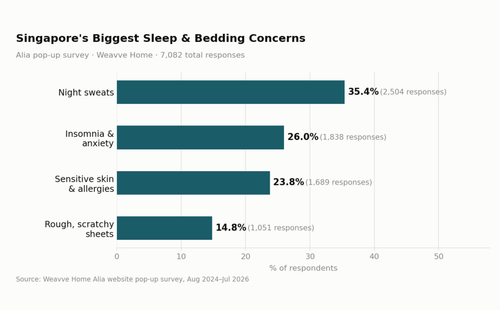
Here's what our 7,082 survey responses revealed, collected via our website between August 2024 and July 2026:
Night sweats came out on top at 35.4%, followed by insomnia and anxiety at 26%, sensitive skin and allergies at 23.8%, and rough or scratchy sheets at 14.8%.


We also looked at whether the concerns differed between people visiting our site for the first time versus those who'd been back before. Night sweats was the top concern in both groups, but among returning visitors, sensitive skin and rough sheets both rose. Scratchy sheets, in particular, jumped from 13.5% to 16.6%, the steepest shift of any concern. The more someone has thought about their bedding, the more texture seems to matter.


Night Sweats: Singapore's Most Common Sleep Problem
Waking up damp at 3AM isn't a "you" problem. It's a Singapore problem.
Our bedrooms are, on average, 28.4°C through the night, according to a 2023 NUS HEATS study of indoor temperatures in Singapore.
For context, sleep scientists generally recommend a room temperature of around 18–20°C for good sleep onset. We're sleeping almost 10 degrees above that. And here's why it matters: your body needs to drop its core temperature by about 1°C to initiate sleep. In a room this warm, that process takes longer, and anything trapping heat against your skin is actively working against it.
So when more than one in three people in our survey named night sweats as their top concern, it wasn't surprising. It was just nice to have the numbers to back up what most of us already know from experience.

|
Worth noting: Night sweats aren't always about the heat. Hormonal changes, with menopause being one of the most common, can also cause significant nocturnal sweating regardless of room temperature. In those cases, breathable or cooling bedding helps by reducing the additional layer of heat trapped against the skin. But if night sweats persist, it's worth speaking to a doctor. |
What Your Sheets Have to Do With It
Here's the thing about fabric: it's not passive. A 1987 study in the American Journal of Physiology found that sweating rates are actually highest during deep sleep, the phase when your body is working hardest to regulate its temperature. What's pressed against your skin in those hours makes a real difference.
Polyester and microfibre trap warmth and hold moisture close to the skin, which makes the sweating cycle worse. TENCEL™ Lyocell does the opposite: it wicks moisture away and allows more airflow, so your body can do what it's trying to do.
If you've been sleeping on the wrong sheets for years without realising it, switching to our cooling TENCEL™ bedsheets here at Weavve Home is one of the quickest, lowest-effort changes you can make. The fabric composition is the place to start, and not the thread count alone.



Insomnia and Anxiety: When the Mind Will Not Switch Off
If you've ever lain awake at 2AM, exhausted but unable to switch off, mind going over tomorrow's to-do list or nothing in particular, you already know this feeling. One in four people who took our survey named it as their biggest sleep concern.
And they're far from alone. Singapore ranks as the most sleep-deprived of 17 countries surveyed in a 2024 YouGov study. Singapore General Hospital has seen a 20% increase in insomnia referrals over the past three years, according to Dr. Leonard Eng, a sleep specialist at the hospital. This isn't just an anecdote. It's a pattern.
What doesn't get talked about enough is the connection between a hot room and a restless mind. When your bedroom temperature is elevated, your body produces more cortisol, the same hormone that makes you feel alert and stressed. Heat isn't just physically uncomfortable at night. It's physiologically activating. Which is part of why so many people find that when they finally cool down, their mind settles too.

Featuring Weavve Home's Weighted Blanket
What Bedding Can Do, and What It Cannot
We're not going to tell you that new bedding alone will cure insomnia. It won't.
If sleep anxiety is significantly affecting your life, Cognitive Behavioural Therapy for Insomnia (CBT-I) is the evidence-based treatment that actually works, and it's worth seeking out.
What a good sleep environment can do is remove one layer of friction. A surface that overheats you, or feels rough against the skin, or sits heavily in humid air creates low-level physiological stress that the nervous system has to manage. Taking that away doesn't fix the underlying cause, but it makes sleep marginally easier to reach.
A weighted blanket in Singapore is worth mentioning here. Deep pressure stimulation is associated with reduced cortisol and a calmer nervous system. In Singapore's heat, it works best paired with our moisture-wicking bed sheets made of pure TENCEL™ Lyocell.


Sensitive Skin and Allergies: Why Singapore Makes This Harder
If your skin tends to flare, feel itchy, or never quite settle overnight, Singapore's climate is partly to blame.
There's a reason sensitive skin feels harder to manage in Singapore than in cooler climates, and it comes down to something most people don't think about: dust mites. They thrive in temperatures above 20°C and humidity above 50%.
Singapore sits at 70–85% humidity year-round, with temperatures that never drop low enough to naturally thin out the mite population. In places with cold winters, that happens automatically every year. Here, it never does.
Dr. Y.T. Pang, an ENT specialist at CENTAS Medical, has noted that dust mite sensitivity is among the most common drivers of allergic rhinitis in Singapore, and bedding is their primary habitat.

Featuring Weavve Home's Signature TENCEL™ Classic Set
Put that together with the fact that you're spending roughly seven hours a night with your skin pressed against your sheets, and fabric stops feeling like a neutral choice.
What Is Actually in Your Sheets
Most people assume a sheet that feels soft is safe for sensitive skin. That is not always the case. Synthetic dyes and chemical finishing agents are common hidden irritants in mass-market bedding. They are rarely disclosed on the label.
OEKO-TEX® Standard certification tests for more than 100 harmful substances in textiles. It is the clearest signal that a fabric has been independently checked. It's worth looking for beyond just the feel.
As for the material, TENCEL™ Lyocell is naturally hypoallergenic, and its smooth surface reduces overnight friction against the skin. This matters especially for anyone prone to eczema. If you've ever wondered whether your sheets could be causing skin reactions, that piece covers the most common culprits.
For sensitive skin and allergies, your duvet and mattress protector matter just as much as your sheets. A TENCEL™ Lyocell Duvet helps reduce heat and moisture around the body, while its smooth, hypoallergenic material feels gentle against sensitive skin.
A TENCEL™ Mattress Protector adds a washable, moisture-wicking layer between you and the mattress, helping to reduce exposure to dust mites and other allergens that can build up beneath the sheets.
One more thing: night sweats and sensitive skin are a particularly uncomfortable pairing. Moisture that gets trapped against your skin by non-breathable fabric worsens both. It keeps the skin damp and creates exactly the warm, humid conditions that dust mites need. Breathable, moisture-wicking bedding addresses both at the same time.


Rough, Scratchy Sheets: The Problem That Builds Slowly
You know the feeling: you bought a set of sheets, they were lovely for a few weeks, and then gradually, wash by wash, something changed. The texture got rougher. They started to feel stiff at the hems. You're not sure when exactly it happened, but the sheets you have now feel nothing like the sheets you bought.
More than 1,000 people in our survey named this as their number-one concern. And among people who'd visited our site more than once, it was the concern that rose most sharply, jumping from 13.5% to 16.6%. The more someone has paid attention to their bedding, the more this particular frustration seems to surface.

Featuring Weavve Home's Signature TENCEL™ Classic Set
Why It Happens
Short-staple cotton fibres (the kind used in most affordable sheet sets) break and pill with repeated washing. Harsh detergents and high heat in the dryer speed the process along. After enough cycles, the surface loses its integrity and starts to feel rough or scratchy against the skin.
Longer-staple fibres hold their structure better. Our 100% pure Cotton bedlinen made of extra long staple fibres, in particular, has a smooth fibre composition that stays consistent through multiple washes. We designed it to get softer over time because we believe the sheet you sleep on in month six should feel like the one you first put on the bed.
If you’re looking for that silky smooth bedsheet crafted through ethical practices, then you will definitely love our TENCEL™ bedsheets. The fibres are ultra fine so they do not break to the surface and irritate the skin. The first time you will glide your fingers over the fabric, you’ll immediately notice the silky cool feel it has.

Featuring Weavve Home's Cotton Bed Sheet Set
For a broader look at what works in Singapore's climate — covering material, construction, and care — our guide to the best bedsheets for Singapore's heat is a useful place to start.

A Few Other Things People Told Us
Most responses fell into the four categories above, but a smaller group of people wrote something in the open field, and some of those answers were worth pausing on.
Around 14 people mentioned physical pain: neck aches, shoulder pain, restless legs. These sit in a different category from bedding concerns, and we're not going to pretend a sheet set fixes musculoskeletal issues. But a pressure-free, smooth sleeping surface tends to be one of the first environmental recommendations alongside medical treatment, for good reason.
A few mentioned menopause specifically. We touched on this under night sweats, but it's worth naming directly: hormonal sleep disruption is a real, common, and often underdiscussed issue. It deserves more than a passing mention in a survey result.

Featuring Weavve Home's Signature TENCEL™ Classic Set
Frequently Asked Questions
Why do I sweat so much in my sleep in Singapore?
Singapore's year-round heat and humidity (averaging 27 to 30°C and 70 to 85 per cent humidity) raise your body's baseline temperature. This makes it harder to drop the roughly 1°C of core heat needed for sleep onset.
Night sweats turned out to be the most common concern in our survey, cited in more than one in three responses. It is extremely common here, and cooling bedding like our TENCEL™ bedsheet genuinely helps.
What is the difference between night sweats and just feeling hot at night?
Feeling hot is a response to your environment: a warm room or heavy bedding. Night sweats are episodes of excessive sweating that occur regardless of room temperature, often soaking sheets or sleepwear.
Both are common in Singapore. If night sweats persist even with a cool room and light covers, it is worth speaking to a doctor, as hormonal causes, including menopause, are common.
Can bed sheets cause or worsen night sweats?
Yes. Polyester and microfibre are hydrophobic, which means they do not absorb moisture. They hold it against the skin and amplify the sweating cycle. TENCEL™ Lyocell wicks moisture away from the body and releases it through evaporation. Switching fabrics is one of the most immediate, low-effort changes you can make before exploring other causes.
Is insomnia common in Singapore?
Very. Singapore ranked the most sleep-deprived of 17 countries in a 2024 YouGov study. Singapore General Hospital has reported a 20% increase in insomnia referrals over three years. In our own survey, insomnia and anxiety was the second most common sleep concern, named in 26% of responses. You are not alone in this.
What bedding is best for sensitive skin in Singapore?
Look for OEKO-TEX® certified fabrics that have been tested free of synthetic dyes and chemical finishing agents. TENCEL™ Lyocell is naturally hypoallergenic, smooth-surfaced to reduce skin friction, and moisture-wicking. In Singapore, where dust mites are active year-round, OEKO-TEX® Standard certification, which covers over 100 harmful substances, is the benchmark worth looking for.
Why are dust mites worse in Singapore than in other countries?
Dust mites thrive at temperatures above 20°C and humidity above 50 per cent. Singapore's year-round climate sits well above both thresholds, and there is no cold or dry season to naturally reduce mite populations. In temperate climates, winter does this automatically. Here, bedding remains a permanent habitat. Smooth, moisture-wicking, OEKO-TEX® certified fabrics reduce the conditions mites need to survive.
Can a weighted blanket help with sleep anxiety in Singapore?
It can. Deep pressure stimulation is associated with reduced cortisol and a calmer nervous system. For anxiety-driven insomnia, many people find it easier to settle under a weighted blanket. In Singapore's heat, pair it with cool, breathable TENCEL™ bed sheets and duvet covers to manage the added warmth. For chronic insomnia, CBT-I remains the evidence-based first-line treatment.
Why do my sheets feel rough and scratchy after a few months?
Short-staple cotton fibres break and pill with repeated washing, especially with harsh detergents or high-heat drying. Each laundry cycle degrades the surface a little further. Cotton bedsheets with longer-staple fibres hold their surface integrity over time. If your sheets have gone rough, the issue is almost always the fibre quality, not the washing routine.
The Right Bedding for Your Sleep Concerns
The four concerns people raised in our survey (night sweats, insomnia, sensitive skin, scratchy sheets) are all real, all common in Singapore, and all made worse by the wrong bedding.
The right bedding does not fix everything. It does not cure hormonal night sweats, resolve chronic insomnia, or eliminate a dust mite allergy. What it does is remove one layer of discomfort from a problem that already has enough layers.
If any of these concerns sound familiar (and if our survey is anything to go by, they probably do), our hotel-quality, breathable bedding here at Weavve Home was designed for exactly this. Breathable. Smooth. OEKO-TEX® certified. Built for Singapore nights.
This article is brought to you by Weavve Home, a Singapore bedding brand specialising in 100% TENCEL™ Lyocell bedlinen designed for the local climate. Browse the TENCEL™ Lyocell Bedsheets Collection to start.