At a glance
- Most BTO defects surface in the first year, so check thoroughly right after key collection.
- A bathroom floor that doesn't slope to the drain was Mrs Wee's biggest regret.
- You can check the flat yourself with a coin, tape and a pail, or hire a professional for S$180 to S$780.
Quick tips
- Pour a pail of water across the bathroom floor and check that it runs straight to the drain.
- Tap every floor tile with a coin and mark any that sound hollow with tape.
- Walk every room barefoot to feel for dips in the vinyl flooring.
- Open, close and lock every door and window, including those in the kitchen and service yard.
- Report all defects at your Building Service Centre before renovation starts.
Most mornings in the Wee household start the same way. Someone showers, the water is switched off, and a thin film stays behind in the corners of the bathroom floor, going nowhere. So out comes the squeegee.
Mrs Wee, a first-time homeowner who bought her flat at Eunos Court with her family, can trace that daily ritual back to one afternoon: the day they did their BTO defect check. Readers may remember her from our comprehensive guide to buying a BTO flat in Singapore. This time we asked her a different question: looking back, what would she have checked more carefully?
“I know people who are very particular about defects so they will hire a professional to check. We weren’t too particular so we checked ourselves and our contractor offered to help us check too.”
(Mrs Wee, First-Time Homeowner, Eunos Court)
Defects in a new flat are normal, and most are small. When HDB's numbers were shared in Parliament in 2020, they showed that new owners report about 2.6 defects per flat in their first year, and almost none after that. About nine in ten defect reports arrive in that first year. In other words, the first year is your window. What you let slide during it is what you live with.

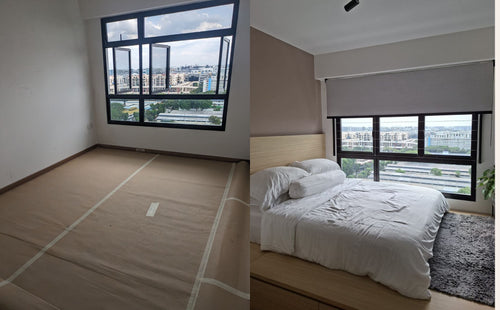
An empty flat is the easiest time to spot what needs fixing
The Puddle in the Corner
Ask Mrs Wee for one piece of advice and she doesn't hesitate.
“My number one tip (we didn’t know better!) Check that water flows easily towards the drain.”
(Mrs Wee)
It sounds almost too simple, which is exactly why it gets skipped. Her bathroom floor looked fine on the day. It was only once the family moved in that the problem showed itself.
“We have water pooling at the corners of our bathroom because the floor isn’t properly sloped towards the drain. We now have to squeegee the water every day.”
(Mrs Wee)
Singapore's Building and Construction Authority (BCA) is clear on this in its tiling guidelines: bathroom and kitchen floors should slope gently towards the drain, and water shouldn't be left sitting anywhere on the floor. Corners are the usual trouble spot. In 2025, local renovation firm Reno Scout pointed out that water tends to gather in bathroom corners, and the problem gets worse once a shower screen goes in and blocks the water's path (as reported by The Online Citizen).
In our climate, that matters more than it might elsewhere. With humidity regularly above 80%, a bathroom floor that doesn't drain stays damp for hours, and damp corners are where mould and grime settle in.
The good news is that the test takes five minutes. Your water and electricity are already switched on when you collect your keys, as SP Services arranges this for new BTO owners; you just need to open your utilities account within three days. So:
- Fill a pail and pour it across the bathroom floor, starting from the corners furthest from the drain (Stacked Homes recommends the same test).
- Watch where the water goes. It should run to the floor trap without stopping along the way.
- If it pools, mark the spot with tape and take a photo.
One caveat: when Fernvale Dew residents reported pooling in 2023, HDB found that debris left in the drains was partly to blame (Mothership). Clear the floor trap first so you're testing the floor, not the leftover construction dust.

A floor that doesn't drain properly becomes a daily chore. Photo from Mrs. Wee.
Checking It Themselves, With the Contractor in Tow
Mrs Wee's family didn't hire a professional inspector, and they're not alone. For a 4-room HDB flat, a professional defect check in Singapore costs roughly S$180 to S$780 depending on the company, according to a 2026 roundup by Home & Decor. Some homeowners see that as money well spent; others would rather put it towards the renovation.
On HardwareZone's forums, the DIY crowd's advice is refreshingly low-tech: a coin, a roll of tape and a measuring tape will get you most of the way, and many owners walk the flat with their interior designer or contractor. Not everyone enjoys it, though. One owner who did it alone called the process "so tiring, time consuming and unprofessional".
Doing it yourself also changes your expectations. A couple who checked their own flat in 2023 told MS News: "Even though the house wasn't perfect, we think defects and imperfections are common." Mrs Wee came to a similar place.
“We checked the defects ourselves and thankfully found no major issues. There were some minor tiles and window pane issues.”
(Mrs Wee)
Having the contractor along helped. A contractor who is about to renovate your flat has every reason to spot problems early, because anything missed now becomes their headache later.
What She Checked, Door to Floor
Mrs Wee's own BTO defect checklist was short and practical. Here it is, item by item, with what "good" should look like.
Doors
“Make sure all doors can open, close and lock properly. Also check that they aren’t scraping against the floor.”
(Mrs Wee)
BCA's quality standard for new homes gives a handy yardstick: a door should open, close and lock without a fight, and the gap around it shouldn't be wider than about 5mm, a little thinner than a pencil.
Windows
“Check that all windows can open and close smoothly and easily.”
(Mrs Wee)
Open every window fully, close it, and lock it. The Wees found minor window pane issues this way, so don't skip the smaller windows in the kitchen and service yard.
Walls and floors
“Look out for any cracks.”
(Mrs Wee)
The rule of thumb is simple: if you can see a crack with your own eyes, report it. A torch held flat against the wall shows up hairline cracks that disappear in daylight.
Floor tiles
“Check for cracks in the tiles and chipped or damaged grout.”
(Mrs Wee)
Look for more than cracks, though. Tap each tile with a coin. A solid knock is good; a hollow, papery sound means the tile isn't fully stuck down. Wong Chung Wan, an engineer at Singapore testing lab Setsco, found in his research on tile failures that even small hollow patches along a tile's edges can lead to serious cracking later. It isn't rare, either: HDB handles around 2,000 cases of lifting or popping floor tiles a year, which it links to heat making tiles expand and contract, and the glue weakening over time.
While you're down there, run your palm across the joins. BCA's guidelines say neighbouring tiles should sit flush, within half a millimetre of each other, which is less than the thickness of a credit card.
|
What to check |
The quick test |
What good looks like |
|
Bathroom and kitchen floors |
Pour a pail of water from the far corners |
Water runs to the drain with no puddles |
|
Doors |
Open, close and lock each one; watch the bottom edge |
Moves easily, locks cleanly, no scraping |
|
Windows |
Open fully, close and lock |
Slides smoothly with no gaps or rattles |
|
Walls |
Shine a torch along the surface |
No cracks you can see |
|
Floor tiles |
Tap with a coin; feel the joins |
A solid sound and flat, even edges |
|
Vinyl flooring |
Walk barefoot; lay a long straight edge down |
No dips, dents or soft spots |
Your kit doesn't need to be fancy. Home & Decor's key collection checklist puts most of it under S$15 an item on Shopee: a tapping rod (about S$8.50, though a coin works), blue painter's tape to mark defects (about S$5.60), a 5L pail for the water test (about S$4.90), and a phone charger to test every power socket.

A measuring tape, a coin and a roll of tape cover most of a DIY check
The Dip She Still Feels Underfoot
Her one other regret is the kind that only shows up once you've lived somewhere for a while.
“Check that the flooring is properly aligned and look out for any dents or dips in the floor. We noticed a dip in one of our rooms but weren’t too bothered by it at the time. Now I feel it every time I step into the room and wish I had gotten it fixed!”
(Mrs Wee)
"Minor" is a judgement call you make once and live with for years. BCA's guidelines allow only about 3mm of rise or dip across 1.2m of floor, a stretch a little wider than a super single bed. If you can feel it underfoot, it is worth flagging.
She isn't the only one bothered by it. "Walking on 'hollow' floors drives me bonkers," one homeowner wrote on HardwareZone. Another forum member estimated that fixing a big dip after moving in means lifting the vinyl and redoing the floor underneath, at around S$1,000. That is far more hassle than flagging it during your first year.
The test suits how most of us live at home anyway: barefoot. Walk every room slowly, then lay a spirit level or a straight broom handle across any spot that feels off. If light shows underneath, mark it.
Before the Renovation Starts, Report It
For all the worry, the official side of things is the easy part.
“Key collection process was easy and straightforward.”
(Mrs Wee)
Every new estate has a Building Service Centre (BSC) on site for the first year. You can report defects there or online. Go in person and you can book a joint inspection with HDB's team on the spot; report by email and they'll contact you within three working days. HDB aims to complete repairs within 14 working days, and it reported in 2023 that more than nine in ten defects were fixed within that time.
That first year is called the defect liability period. After it ends, HDB's guidance is to engage your own repair contractor, although some issues stay covered for longer: ceiling leaks and seepage through external walls for five years, and spalling concrete for ten.
The timing advice from every HDB defect check guide we read is the same: report everything before your renovation starts. PropertyGuru suggests doing it within a month of key collection, and homeowners on HardwareZone warn that once a contractor has started work, it gets much harder to show a defect was there from the beginning.

Featured Product
TENCEL™ Lyocell Mattress Protector
100% waterproof, whisper-quiet and OEKO-TEX® certified, with a breathable TENCEL™ Lyocell surface.
Shop Now
Frequently Asked Questions
How long is the BTO defect liability period?
It lasts one year from key collection. During that time, HDB's Building Service Centre in your estate handles defect reports and repairs. After that, you engage your own contractor, although ceiling leaks and external wall seepage stay covered for five years.
Is water available during a BTO defect check?
Yes. SP Services switches on water and electricity for new BTO owners before they move in, so you can run the bathroom water test and check every socket on key collection day. You need to open your utilities account within three days of collecting your keys.
Should I hire a professional for my HDB defect check?
It depends on your budget and patience. Professional checks for a 4-room flat cost roughly S$180 to S$780. Many owners check it themselves with their contractor or interior designer, using a coin, tape, a pail of water and a torch.
Can I still report defects after renovation?
You can, but it gets harder. Once renovation work starts, it can be difficult to show a defect was there from handover rather than caused by your contractor. Report everything to the Building Service Centre before work begins, ideally within the first month.
How do I check if my bathroom floor slopes to the drain?
Clear the floor trap, then pour a pail of water across the floor, starting from the corners furthest from the drain. The water should flow straight to the floor trap. If it pools anywhere, mark the spot with tape, photograph it and report it.
Start Your First BTO Nights Cool, Not Clammy
Mrs Wee's squeegee is a small daily reminder that what you check in that empty flat shapes how the home feels for years. Take your time, run the water, tap the tiles and walk the floors barefoot. Once the defects are reported and the dust has settled, the first night in your new home deserves the same care.
In a Singapore flat where the nights stay warm and humid, that starts with what you sleep on. Our Signature TENCEL™ Bedsheets are made from 100% Lenzing TENCEL™ Lyocell and is OEKO-TEX® Standard 100 certified. It comes with a fitted sheet, a duvet cover and two pillowcases, in sizes from single and super single all the way to Cal King. Browse the full TENCEL™ Lyocell bedsheets collection, or read our guide to the best bedsheets for Singapore weather before your move.

Featuring Weavve's Signature TENCEL™ Classic Set
This guide is brought to you by Weavve Home, a Singapore home brand specialising in TENCEL™ Lyocell bedding designed for the local climate. Browse the TENCEL™ Lyocell Bedsheets Collection to start.