At a glance
- BTO flats are sold directly by HDB before they are built, with waiting times that typically run three to five years from ballot to key collection.
- Eligibility is assessed upfront through the HDB Flat Eligibility (HFE) letter, which also determines your CPF Housing Grant amount and the loan you qualify for.
Quick tips
- Apply for your HFE letter before you know which launch you are targeting.
- Budget your all-in costs, not just the renovation quote.
- Check every priority scheme you might qualify for before submitting.
Buying a Build-to-Order flat is one of the biggest financial decisions most Singaporeans will ever make, and one of the most opaque. You are committing hundreds of thousands of dollars to a flat you have never seen, in a location that may only be a road name and a site map, for a home that will not exist for another three to five years.

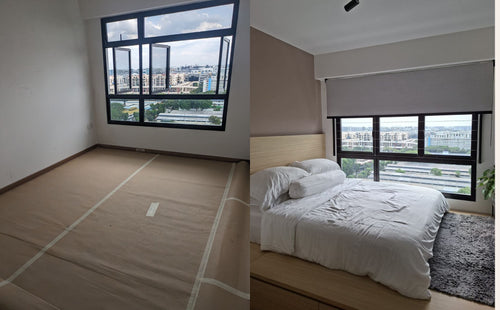
The blank canvas: a newly handed-over BTO flat
This guide covers every stage: eligibility checks, financing strategy, the ballot, unit selection, the wait, key collection, and the defect inspection. It also covers what the top-line process steps leave out, including how to choose a unit wisely once you get a queue number, what to do during the years of waiting, and the mistakes that catch first-time buyers off guard.
To ground this guide in real experience, we spoke to two Singapore first-timers who have been through the process: Mrs. Wee, who bought a Sale of Balance flat in Eunos in 2021, and Shan, who applied for a Prime BTO in Queenstown in November 2022 and is counting down to her estimated key collection in early 2028. Their experiences and perspectives are woven throughout.
One note on 2024 policy changes: HDB overhauled its flat classification in August 2024, replacing the old Mature/Non-Mature system with a new three-tier model: Standard, Plus and Prime. If you have not applied for a BTO since then, the rules have changed in ways that affect your resale options. The HDB website has the official details.
Who We Spoke To
The buyer experience in this guide comes from two Singapore first-timers who agreed to share their process.
| Mrs. Wee | Shan (pseudonym, anonymous) | |
|---|---|---|
| BTO project | Eunos Court | Queenstown (Prime classification) |
| Application year | 2021 (Sale of Balance Flat) | November 2022 |
| Flat type | 4-room | 4-room |
| Household situation | First-timer with family | First-timer; applied as a couple under the Deferred Income Assessment Scheme (both in university / National Service at the time) |
| Key collection | Completed | Estimated Q1 2028 |
| Loan type | Bank loan (did not meet HDB loan criteria) | Plans to use HDB loan; financing reassessment deferred to 2027 |
| Ballot attempts | Second attempt (first was Kallang SBF) | First attempt |
| Citation preference | Mrs. Wee | Anonymous; pseudonym assigned by Weavve Home |
Their responses appear throughout this guide where their specific experience is relevant.
What Is a BTO Flat? How the Classification System Works
Build-to-Order (BTO) flats are public housing units sold by the Housing Development Board before construction begins. You apply, ballot for a queue position, book a unit, wait for construction to complete (typically three to five years), then collect your keys and move in. HDB sets the price below market value, with the subsidy recovered through resale restrictions.
Since August 2024, all new BTO flats are classified under one of three tiers.
| Classification | Location | Subsidy Level | Resale Restrictions | Min. Occupation Period |
|---|---|---|---|---|
| Standard | Anywhere outside Plus/Prime areas | Standard | None beyond standard MOP | 5 years |
| Plus | Good transport, amenities, or central locations | More subsidised | Income ceiling + clawback on resale | 10 years |
| Prime | Best-located estates (central, mature towns) | Most subsidised | Income ceiling + higher clawback on resale | 10 years |
The key implication: Plus and Prime flats come with a 10-year Minimum Occupation Period instead of the standard five years. When you sell, HDB will also claw back a percentage of the resale profit (the subsidy recovery mechanism). The exact clawback percentage for each project is published with the launch details. Do factor this in when comparing BTO prices to resale prices: the BTO headline price is lower, but the exit cost is higher.
Are You Eligible to Buy a BTO Flat?
HDB sets eligibility requirements across several dimensions. You need to meet all of them before applying. The HFE letter (covered in Step 1) is HDB's formal confirmation, but checking these criteria yourself first avoids wasted time.
| Eligibility Criterion | Requirement |
|---|---|
| Citizenship | At least one applicant must be a Singapore Citizen. The other can be a Citizen or Permanent Resident. PR-only applications are not eligible for BTO. |
| Age | At least 21 years old for families. At least 35 years old for singles applying under the Single Singapore Citizen Scheme. |
| Family Nucleus | Must form an eligible family unit: married/engaged couple, parent(s) with children, siblings (under Joint Singles Scheme), or a Singapore Citizen widowed/divorced parent with children. |
| Income Ceiling | Monthly household income must not exceed the ceiling set for that flat type (see below). |
| Property Ownership | Must not own private residential property locally or overseas at the time of application. If you own a HDB flat, additional restrictions apply. |
| Previous Subsidised Flat | Second-timers (who previously received a housing subsidy) get fewer ballot chances and a smaller slice of available units. |
| Ethnic Integration Policy | Each block has ethnic quotas to ensure racial balance. If a project's quota for your ethnic group is full, you cannot buy there even if you are otherwise eligible. |
Income Ceilings by Flat Type
The income ceiling is based on your gross monthly household income, averaged over the 12 months before your HFE application. All applicants' income is counted.
| Flat Type | Income Ceiling (Household) | Notes |
|---|---|---|
| 2-Room Flexi | S$7,000 | Or S$14,000 for seniors; also available for singles |
| 3-Room | S$7,000 (Standard) / S$14,000 (Plus/Prime) | Varies by estate classification |
| 4-Room and larger | S$14,000 | Standard ceiling for most family applications |
| 5-Room or 3Gen (Plus/Prime) | S$14,000 | Same ceiling; location-based restrictions apply |
| Executive | S$16,000 | For joint income of extended family households |
Singles: What You Can Apply For
Under the Single Singapore Citizen Scheme, you must be at least 35 years old and apply alone or with other singles under the Joint Singles Scheme. Singles can apply for 2-Room Flexi flats in any estate. They cannot apply for larger flat types under the standard BTO scheme, though resale HDB is available for most flat types.
The Deferred Income Assessment scheme is available for younger couples where one or both applicants are full-time National Service men or students. Income assessment is deferred until after key collection. Check HDB's eligibility page for the current criteria.

A freshly handed-over BTO bedroom before renovation
Step 1: Apply for Your HFE Letter Before Anything Else
The HDB Flat Eligibility (HFE) letter replaced the old HLE letter in May 2023. It is a single document that tells you three things at once: whether you are eligible to buy a BTO flat, what CPF Housing Grants you qualify for, and (if you want an HDB loan) how much you can borrow.
You need a valid HFE letter before you can submit a BTO application. HDB will not process an application without one. Apply via My HDBPage using your SingPass. The assessment typically takes three to four weeks, and the letter is valid for nine months from the date of issue.
Apply for the HFE letter at least a month before the BTO exercise you plan to apply in. The February, June, and October launch windows are announced several months in advance, giving you time to plan.
If you are applying with a bank loan rather than an HDB loan, you will apply for an Approval-in-Principle (AIP) from your bank separately. The HFE letter is still required for BTO eligibility, but it will not include a loan amount assessment in that case.
Step 2: Plan Your Finances Before the Next Launch
Your HFE letter will tell you what you can borrow. That is different from what you should borrow. Running through the full cost picture before a launch helps you decide which flat type and estate make realistic sense for your budget.
HDB Loan vs Bank Loan
The two main financing paths have meaningfully different terms in 2026.
| HDB Concessionary Loan | Bank Loan | |
|---|---|---|
| Interest Rate | 2.6% per annum (pegged to CPF OA rate + 0.1%) | Variable; typically 1.2% to 2.5% in 2026 depending on package |
| Loan-to-Value (LTV) | Up to 80% of flat price or value | Up to 75% of flat price or value |
| Downpayment | 20% (can use CPF OA entirely) | 25% minimum (5% must be in cash) |
| Flexibility | Fixed rate, no refinancing risk | Can refinance; rate exposure after lock-in period |
| Eligibility | Must meet HDB income ceiling; valid HFE required | Any bank offering HDB loans; AIP required |
| Lifetime Limit | Two HDB concessionary loans per household | No formal cap |
| Switch Option | Can refinance to bank loan after key collection | Cannot switch to HDB loan once on bank loan |
A useful heuristic: if rate certainty matters more to you, the HDB concessionary loan at 2.6% is predictable and requires no cash for the downpayment (all CPF). If you are comfortable with interest rate risk and can service a 25% downpayment with cash, bank loans in 2026 have been running lower than the HDB rate. The right choice depends on your CPF balance, savings, and risk appetite.
Not everyone qualifies for an HDB loan. Mrs. Wee's household exceeded the income ceiling for HDB loan eligibility at the time of application, which meant a bank loan was the only option.
“We had to take a bank loan as we did not meet the criteria for an HDB loan. There were no budgeting surprises.”
(Mrs. Wee)
CPF Housing Grants
For new BTO flats, the primary grant available is the Enhanced CPF Housing Grant (EHG). Apply through your HFE letter: the CPF Housing Grant page has the full eligibility criteria.
| Grant | Who It's For | Maximum Amount |
|---|---|---|
| Enhanced CPF Housing Grant (EHG) | First-timer families buying a new BTO flat from HDB; income-tested | Up to S$120,000 |
| EHG (Singles) | Singles buying a 2-Room Flexi BTO under the Single Singapore Citizen Scheme; income-tested | Up to S$60,000 |
| CPF Housing Grant (Family Grant) | First-timer families buying a resale HDB flat (not applicable for BTO) | Up to S$80,000 |
| Proximity Housing Grant (PHG) | Buying within 4km of parents or child; resale only (not applicable for BTO) | Up to S$30,000 |
Worked Example: What a S$450,000 4-Room Flat Actually Costs
Assumptions: first-timer couple, EHG of S$50,000 (income-tested), HDB loan, 2.6% over 25 years.
| Cost Component | Amount | Notes |
|---|---|---|
| Flat price | S$450,000 | BTO selling price |
| Less: EHG grant | (S$50,000) | Applied to purchase price |
| Net price after grant | S$400,000 | |
| Downpayment (20%) | S$80,000 | Payable in CPF OA or cash |
| HDB loan amount (80%) | S$320,000 | |
| Monthly instalment (25yr, 2.6%) | ~S$1,450 | Estimate; check HDB loan calculator |
| Buyer's Stamp Duty (BSD) | ~S$8,100 | On purchase price (see BSD table below) |
| Legal/conveyancing fees | ~S$3,500 | Approximate; varies by law firm |
| HDB application fee | S$10 | Non-refundable ballot fee |
| Option fee at booking | S$2,000 | For 4-room flat; credited against purchase price later |
| Survey fee (HDB) | ~S$275 to S$410 | Varies by flat type |
| Fire insurance (annual) | ~S$30 to S$90 | Mandatory; varies by flat type |
| Home Protection Scheme (HPS) | Varies by age/loan | Mandatory if using CPF for loan |
Renovation and furnishing costs sit on top of these. Budget a minimum of S$30,000 to S$50,000 for a basic renovation on a 4-room flat, and more for a comprehensive fit-out.
Buyer's Stamp Duty (BSD) Rates
| Purchase Price Tier | BSD Rate |
|---|---|
| First S$180,000 | 1% |
| Next S$180,000 | 2% |
| Next S$640,000 | 3% |
| Next S$500,000 | 4% |
| Next S$1,500,000 | 5% |
| Amount above S$3,000,000 | 6% |
For a S$450,000 flat: 1% on first S$180,000 (S$1,800) + 2% on next S$180,000 (S$3,600) + 3% on remaining S$90,000 (S$2,700) = S$8,100 total.
Staggered Downpayment Scheme
First-time buyers using an HDB loan can split the downpayment across two milestones: a minimum of 5% at the signing of the Agreement for Lease (instead of the full 20%), with the remaining 15% due only at key collection. This reduces the immediate cash or CPF burden at signing and gives buyers more time to accumulate savings during the wait period. The scheme is available for 5-room flats and smaller (for eligible first-timer couples). Check the current HDB criteria when you apply, as eligibility conditions can change.
The scheme can open doors for buyers who would otherwise have no realistic path to a BTO flat. Shan and her partner applied while she was still at university and he was in National Service, both with no income on paper when they submitted their application in November 2022.
“As I applied while we were both unemployed, we had no income on paper. We also had not started saving money yet. With the deferred downpayment scheme, we were quite assured that we did not have to worry too much, as the first downpayment was only 5%.”
(Shan)
Step 3: Monitor BTO Launches and Apply Strategically
HDB holds three BTO sales exercises each year, typically in February, June, and October. Each exercise covers several towns, and the flats on offer are announced several weeks before the application window opens. Application windows are typically one week long.
In 2026, HDB launched a total of approximately 19,600 BTO flats across the three exercises, with more than 4,000 units designated as Shorter Waiting Time (SWT) flats, meaning construction is expected to complete in under three years. SWT flats are released in limited quantities and typically face stronger competition, but they suit buyers who cannot afford a long wait.
How to Read Application Rates Before You Commit
When a launch is open for applications, HDB publishes a live dashboard showing the number of applications received per flat type per project. These application rates update daily during the window. Checking them strategically is the closest thing to controlling your ballot odds.
An application rate of 1.0 means one applicant per unit on average. For first-timers applying for a 4-room flat in a Standard estate, a rate at or below 1.0 virtually guarantees a queue number. In February 2026, 4-room first-timer rates in Tampines reached 6.8, while Sembawang rates came in around 0.6 for the same flat type. If a queue number matters more than the location, the application rate is the key variable to monitor.
Real Ballot Odds by Flat Type (2025 to 2026 Data)
Not all flat types are equally competitive. 2-Room Flexi units in Plus or Prime estates are structurally oversubscribed because supply is small and demand from singles and downsizers is high. 4-room and 5-room flats in newer towns are typically more accessible for first-timers.
| Flat Type | Typical First-Timer Rate (2025 to 2026) | Notes |
|---|---|---|
| 2-Room Flexi (Plus/Prime estate) | 10x to 30x+ | Highest competition; Queenstown Oct 2024 reached 31x |
| 2-Room Flexi (Standard estate) | 2x to 8x | More accessible; demand still strong from singles |
| 3-Room | 3x to 6x (first-timers) | Varies widely by location |
| 4-Room | 4x to 7x (first-timers) | Tampines was 6.8x in Feb 2026; Sembawang was around 0.6x |
| 5-Room | 2x to 4x (first-timers) | Largest supply; most accessible for families |
HDB reserves at least 95% of 4-room and larger units, and 85% of 3-room units, in Standard BTO projects for first-timer families. This structural set-aside means second-timers face much steeper odds for the same flat type. In the February 2026 exercise, second-timers competing for the same 4-room Tampines flats faced an application rate of 35.3 versus 6.8 for first-timers.
Queue numbers do not guarantee a flat. HDB shortlists more applicants than there are units (sometimes up to 200% of supply), so whether you actually get to book a flat depends on how many units remain when your number comes up at the booking appointment.
Priority Schemes: Who Gets Extra Queue Position Weight
HDB operates several priority schemes that set aside a portion of units for qualifying applicants. Schemes are not exclusive: you can qualify for multiple, and each one increases your chances independently. Details are on the HDB priority schemes page.
| Priority Scheme | Who Qualifies | Set-Aside (Approx.) |
|---|---|---|
| Family and Parenthood Priority Scheme (FPPS) | Married couples with at least one SC child, or pregnant couples | Up to 40% of supply in each project |
| Family Care Scheme (FCS) | Buying within 4km of parents or children (one party must be SC) | Up to 30% of supply |
| Third Child Priority Scheme (TCPS) | Families with at least three SC children | Up to 10% of supply |
| Tenants' Priority Scheme (TPS) | Current HDB rental flat tenants with SC children | Up to 10% of 2-room Flexi and 3-room units |
| Assistance Scheme for Second-Timers (ASSIST) | Second-timers with SC children in specific circumstances | Up to 5% of 4-room and larger units |
The ballot result is when luck enters the picture. Mrs. Wee was unsuccessful on her first attempt at Kallang SBF before securing Eunos on her second try. Shan got a queue number on her very first application, which did not make the results any less tense.
“It was definitely exciting and nerve-wracking. I was checking the site every few hours to see if the results were out. So many couples have complained about multiple attempts, and I was torn between being hopeful and also being ready for disappointment.”
(Shan, on waiting for her ballot result)
Step 4: You Have a Queue Number. Now Choose Your Unit Wisely.
Most BTO guides stop at "congratulations, you got a queue number." The unit selection appointment is where the real decision-making happens, and most buyers are underprepared for it.
HDB will invite you to a booking appointment based on your queue position. At the appointment, you choose from the units still available in your assigned project. The earlier your queue number, the more units remain. Late queue numbers sometimes face a situation where only the least popular units (specific facings, low floors and end blocks) are left.
How to Prepare Before Your Appointment
HDB publishes a unit plan for each project showing the block layouts, unit types, and floor plans. Study this before your appointment. Key variables to evaluate:
| Factor | What to Look For | Singapore-Specific Consideration |
|---|---|---|
| Sun orientation | Which direction does the unit face? | West-facing units get direct afternoon sun from around 1 pm to 7 pm. Singapore's heat and humidity make west-facing units noticeably warmer year-round. North-south facing is preferred. |
| Floor level | How high is the unit? | Higher floors have better ventilation and views, but top-floor units can be warmer because of heat gain through the roof. Ground-floor units can have pest and privacy issues. |
| Proximity to common areas | Is the unit near a lift lobby, rubbish chute, or bin centre? | Noise, smell, and footfall; closer is generally less desirable. |
| Views | What does the unit look out onto? | Check the master plan for future developments in the same direction. An open view now may be blocked by new construction in 10 years. |
| Stack and layout | Corridor unit vs corner unit? | Corner units get more natural ventilation but may have additional walls facing the exterior, which affects heat gain. |
| Surrounding blocks | How close are neighbouring blocks? | Dense block spacing reduces cross-ventilation and privacy. Check the site plan for the distance between blocks. |
You are allowed to bring the site plan and floor plans to the booking appointment. Study them thoroughly in advance so the decision at the counter is confirmation rather than deliberation.
Option Fee at Booking
When you book a unit at the appointment, you pay an option fee. This is credited against the purchase price later.
| Flat Type | Option Fee |
|---|---|
| 2-Room Flexi | S$500 |
| 3-Room | S$1,000 |
| 4-Room | S$2,000 |
| 5-Room and Executive | S$2,000 |
Both respondents approached location differently based on their household priorities.
“Location is a priority because we want convenience. It has to be close to the central area and near public transport. We also had to consider the number of units available. We had a few locations to choose from and not all of them had good schools nearby.”
(Mrs. Wee)
“I looked at proximity to MRT, nearest bus stop and the buses available, how far it is from both our parents' houses, how far from both our workplaces, food near the area, and whether it would be noisy, like being away from a school or fire station.”
(Shan)

Key collection day at HDB Hub
Step 5: Sign the Agreement for Lease
After booking, HDB will notify you of the date to sign the Agreement for Lease (AFL). This is typically within 4 to 9 months of your booking date, depending on construction progress. The AFL is the formal sale and purchase agreement; signing it legally commits both parties.
What You Pay at AFL Signing
| Payment | Details |
|---|---|
| Downpayment | 20% of purchase price for HDB loan (less any option fee paid at booking). If using Staggered Downpayment Scheme, minimum 5% is due here, with the remaining 15% deferred to key collection. |
| Buyer's Stamp Duty (BSD) | Must be paid within 14 days of signing. Payable in cash or CPF. |
| Legal/Conveyancing fees | Payable to your appointed solicitor. Typically S$2,500 to S$4,000 for an HDB flat. |
| CPF Housing Grant | Grant is credited to your CPF OA account. You use it to offset the downpayment, not as a cash payment. |
If you cannot attend the AFL signing in person (for example, you are overseas), you can appoint a representative through a Power of Attorney. Contact HDB and your solicitor well in advance to arrange this, as the documentation requirements require lead time.
For Shan, the gap between her November 2022 application and her first booking appointment in June 2023 was seven months. Her AFL signing came seven months after that, in January 2024.
“By the time of the lease signing, we had additional CPF interest accumulated, which helped. We got to sign the lease and pay our first 5% plus stamp duty.”
(Shan)
After signing the AFL, you do not make any further payments until key collection. This is the period most buyers refer to as "the wait."
The Wait: What to Do in the Years Before Key Collection
For most buyers, the gap between signing the AFL and collecting keys is three to five years. Most guides ignore this period almost entirely. It is actually the time when the smartest preparation happens.
Financial Planning During the Wait
Your circumstances may change significantly over three to five years. Income can increase or decrease. You might have children. One partner might stop working temporarily. If your income drops below the HDB income ceiling and you were relying on an HDB loan for a specific amount, this is not usually a problem, since the loan amount was locked in at the HFE stage. However, if your circumstances change dramatically (marriage status, citizenship, new property purchase), contact HDB promptly, as some changes need to be declared and can affect your eligibility.
Use the wait period to build your renovation savings. BTO renovations typically cost between S$30,000 and S$80,000 depending on the scope. Getting multiple quotes from renovation contractors in the year before key collection is realistic and gives you time to plan the fit-out properly.
What Happens If Construction Is Delayed
HDB publishes construction progress updates on its website and sends direct notifications. If completion is delayed beyond the original estimate, HDB provides a monthly housing allowance as compensation. The allowance amount depends on your flat type and is paid directly to affected buyers. It does not cover the full cost of continued rental accommodation, but it acknowledges the inconvenience.
Major delays are uncommon for standard BTO projects, though the 2020 to 2022 period saw significant delays due to construction supply chain disruptions. Projects launched since 2023 have generally returned closer to their original timelines.
Renovation Research: Start Earlier Than You Think
The renovation process for a BTO flat typically takes two to four months from contractor appointment to completion. Interior designers are often booked out six to twelve months in advance. Starting your research one year before your estimated key collection date is not excessive: it is the realistic lead time to get the firm and package you actually want.
Read renovation declarations carefully. HDB permits certain hacking, flooring, and electrical works but has restrictions on specific changes, such as removing structural walls or certain wet area modifications. Your contractor should be familiar with HDB's renovation guidelines.
“The wait is really long. For me, I applied in 2022 and my flat will only be ready in 2028. There is enough time to save, but only if you feel confident with your current partner. It takes a lot of commitment and patience.”
(Shan, Queenstown Prime applicant, estimated key collection Q1 2028)
She also flags a concern that comes up frequently in BTO communities: the renovation process itself.
“I do worry about renovation in the future. I see many people having issues with their interior designer or having to chase contractors.”
(Shan)

Before renovation
Step 6: Key Collection Day
HDB will notify you when your flat is ready for collection. The key collection appointment is typically held at HDB Hub at Toa Payoh. Bring your NRIC or passport and your solicitor's letter of completion (your law firm will coordinate this).
Payments Due at Key Collection
| Payment | Amount / Notes |
|---|---|
| Balance downpayment | If using Staggered Downpayment Scheme, the remaining 15% is due here. Otherwise, your downpayment was fully settled at AFL signing. |
| Home Protection Scheme (HPS) premium | Mandatory if your monthly loan instalments are paid from CPF. Deducted from CPF OA annually. Covers the outstanding loan in the event of death or permanent disability. |
| Fire insurance premium | Mandatory. Covers the flat structure (not contents). Rates range from approximately S$30 to S$90 per year depending on flat type. |
| Service and Conservancy Charges (S&CC) | Monthly maintenance fee charged from the month of key collection. Varies by estate and flat type. |
| Survey fee | If not paid earlier. Ranges from approximately S$160 to S$410 depending on flat type. |
| Legal completion fee | Final disbursement to your solicitor. |
Take your time at key collection. There is no reason to rush the handover inspection on the day itself. What matters more is what you do in the weeks immediately following.
“The key collection process was easy and straightforward.”
(Mrs. Wee)
Defect Inspection: What to Check (and How to Claim)
You have 12 months from key collection to report defects under the Defect Liability Period (DLP). HDB is responsible for rectifying structural defects and workmanship issues that fall within scope. Report via HDB's online defect reporting system. Do not carry out any rectification work yourself on a defect you intend to claim, as doing so may void the claim.
Inspect the flat methodically and document everything with photographs. Use natural light and a strong torch for areas like inside cabinets and ceiling corners.
“We checked the defects ourselves and thankfully found no major issues. There were some minor tiles and window pane issues.”
(Mrs. Wee)
Room-by-Room Defect Checklist
| Area | What to Check |
|---|---|
| Ceilings | Cracks, uneven plaster, water stains, peeling paint, misaligned cornices |
| Walls | Hollow spots (tap gently), cracks, blistered or peeling paint, uneven tiling in wet areas |
| Floors | Hollow tiles (tap each one), chipped or cracked tiles, uneven joins, scratched vinyl |
| Doors | Opens and closes smoothly, no warping, door frame flush with wall, locks function correctly, door stoppers installed |
| Windows | Frame sealed with no gaps, slides or opens smoothly, no condensation between double-glazed panels, mosquito screens intact |
| Electrical | Every power point works (bring a phone charger to test), every light switch operates the correct fitting, circuit breakers correctly labelled |
| Plumbing | All taps deliver water, water pressure adequate, no drips at joints, toilet flushes fully and refills, no leaks at base of toilet |
| Wet areas (bathrooms/kitchen) | Check waterproofing by flooding the floor with 25mm of water for 24 hours and inspecting the ceiling below for leaks (if applicable to your block type) |
| Built-in fittings | Cabinet doors align, drawer slides operate, hinges are tight, wardrobe fittings flush |
| External | Letterbox functions, utility meters readable, gate operates, external walls visible from windows for cracks or spalling |
Keep a log of every defect reported, including the reference number HDB assigns when you submit each claim. Follow up if repairs have not been scheduled within two to three weeks of reporting.

After renovation
Getting Your Bedroom Ready From Day One
After years of planning, the bedroom is often the last thing buyers think carefully about. Renovation dust and construction residue settle on every surface, including your mattress, if you do not protect it.
A mattress protector should go on before the first night. It keeps construction particulates out of the mattress core, extends the life of the mattress, and is far cheaper than replacing or deep-cleaning one that has absorbed months of renovation dust. Once renovation is complete and the flat is clean, it continues doing its job as a barrier against sweat, humidity, and allergens.
For the sheets, Singapore's average humidity of 70 to 85% means standard cotton traps heat and moisture noticeably. TENCEL Lyocell fibres have a naturally smoother, cooler surface and release moisture faster, which makes a measurable difference on warm Singapore nights. Read more in our guide on the best bedsheets for Singapore weather.

Featuring Weavve Home's Signature TENCEL Classic Set
Featured Product
TENCEL Lyocell Mattress Protector
Goes on first, before renovation begins. Protects your mattress against dust, moisture, and allergens from day one.
Shop Now
Featured Product
Sheets, pillowcases, and bolster cases in TENCEL Lyocell. OEKO-TEX certified. Designed for Singapore's climate.
Shop NowCommon Mistakes First-Time BTO Buyers Make
These mistakes do not appear in most BTO guides because they are obvious in hindsight. They are less obvious before you go through the process for the first time.
1. Not Applying for the HFE Letter Early Enough
The HFE letter takes three to four weeks. Many first-time buyers discover this only a week before the application window opens and either miss the exercise entirely or apply without a valid HFE. The letter must be in place before you can submit.
2. Applying Without Checking the Application Rate
Applying for the most popular project in a launch is not a strategy. Once the application window is open, the live rates update daily. Many buyers who waited and switched to a lower-demand project within the same exercise got queue numbers on the first attempt, while buyers who committed early to oversubscribed projects waited years.
3. Ignoring Plus and Prime Resale Restrictions
The 10-year MOP and subsidy clawback on Plus and Prime flats are meaningful. If your plans include upgrading to private property within 10 to 15 years, a Plus or Prime flat may not be compatible with that timeline. Work through the numbers before you apply for those classifications.
4. Underestimating Renovation and Furnishing Costs
Most first-time buyers budget for renovation but not for everything renovation does not cover: furniture, appliances, curtains, lighting, built-in storage not included in the contractor's scope, and small items that add up quickly. A realistic all-in figure for a 4-room flat is S$70,000 to S$120,000 once furnishings are included.
5. Not Checking the Ethnic Integration Policy (EIP) Quota
The EIP sets racial quotas per block and per neighbourhood to maintain ethnic balance in HDB estates. If a project's quota for your ethnic group is at capacity, you cannot buy a unit there. This is not a common issue, but it has caught buyers off guard at the booking appointment when their preferred block was no longer available to them. Check with HDB if you are concerned about a specific project.
6. Choosing a Unit Without Looking at Sun Direction
West-facing units in Singapore receive direct afternoon sun from approximately 1pm onwards. Over a year, the accumulated heat and glare is significant, and it affects both your electricity bill (air-conditioning) and day-to-day comfort. At the booking appointment, knowing your preferred orientation before you see the available units is essential.
BTO vs Resale HDB: How to Decide
BTO and resale HDB both give you public housing in Singapore, but the trade-offs are meaningfully different.
| BTO | Resale HDB | |
|---|---|---|
| Price | Below market; subsidised by HDB | Market rate; negotiated between buyer and seller |
| Wait time | 3 to 5+ years | Typically 8 to 12 weeks from offer to key collection |
| Grants available | Full grant eligibility (EHG up to S$120,000) | Some grants; Proximity Grant adds S$30,000 for nearby parents |
| Flat condition | Brand new; you choose your renovation approach | Varies; may need renovation immediately or may be move-in ready |
| Location choice | Limited to current launches; no choice of estate | Buy anywhere, including areas with no current BTO supply |
| Remaining lease | Full 99-year lease from completion | Depends on age of flat; affects CPF usage and bank loan eligibility |
| Resale restrictions (BTO) | Standard: 5-year MOP. Plus/Prime: 10-year MOP + clawback | Standard 5-year MOP; no clawback |
BTO makes the most sense for buyers who have time flexibility, want a new flat with minimal early renovation liability, and can access full grant eligibility. Resale makes more sense for buyers who need to move quickly, want a specific estate with no active BTO supply, or prefer an established neighbourhood with known amenities.
Both respondents chose BTO for different reasons that reflect these trade-offs.
“We opted for BTO because it is a brand new unit. Resale flats, though they can be larger than new BTOs, can be expensive. With BTO, you are kind of guaranteed better returns. Resale units also mean old and sometimes dirty surroundings.”
(Mrs. Wee)
“I mainly chose BTO because the scheme was in my favour. I would have enough time to save up my CPF and cash reserves. I would not have had enough cash on hand for a resale flat, much less private housing. Sometimes I cannot wait to move out and wish I had chosen resale. But then again, I am not sure I would have gotten such a good area for the price I could afford.”
(Shan)

A renovated BTO dining area
Frequently Asked Questions
How many times can I apply for a BTO flat?
There is no limit on the number of times you can apply. Each unsuccessful attempt earns you additional ballot chances for future exercises (for Standard flats only), increasing your odds over time. However, each application requires a valid HFE letter and a S$10 non-refundable application fee.
What happens if I get a queue number but no suitable units are left when my appointment comes up?
If no units remain in your flat type by the time your queue number is reached, your application is unsuccessful. You will receive an additional ballot chance for future Standard flat exercises. You do not forfeit any fees beyond the initial S$10 application fee.
Can I choose to back out after booking a unit?
Yes, but you will forfeit the option fee you paid at booking. In exceptional circumstances (job loss, serious illness), you may appeal to HDB. Withdrawals are recorded and can affect future eligibility or ballot chances.
Can singles buy a BTO flat?
Yes, but only under the Single Singapore Citizen Scheme, which requires you to be at least 35 years old. You can apply for a 2-Room Flexi flat in any estate. You cannot apply for larger flat types through the BTO scheme, though resale HDB has broader options for singles.
Can I use CPF for the full downpayment?
Yes, if you are taking an HDB concessionary loan. The 20% downpayment can come entirely from your CPF Ordinary Account. If you are taking a bank loan, at least 5% of the 25% downpayment must be in cash; the remaining 20% can come from CPF.
What is the Minimum Occupation Period (MOP) for a BTO flat?
Standard BTO flats carry a 5-year MOP from the date of key collection. Plus and Prime flats carry a 10-year MOP. During the MOP, you cannot sell the flat on the open market, rent out the entire flat, or purchase private residential property.
What happens if my income exceeds the ceiling between application and key collection?
HDB does an income assessment at the point of application, not at key collection. If your income increases after you have been approved and booked a flat, this does not generally affect your eligibility for that flat. However, it may affect your grant amount if the reassessment is triggered by a change of household composition.
How do I check the progress of my BTO construction?
HDB publishes regular completion updates on My HDBPage and sends direct notifications to flat owners. You can also find estimated completion dates on the HDB website under your flat's project details. Visit the construction site periodically if you want a direct view of progress.
What is the Ethnic Integration Policy (EIP) and how does it affect me?
The EIP sets limits on the proportion of flats in each block and neighbourhood that can be owned by each ethnic group. This is to maintain racial integration in HDB estates. If the quota for your ethnic group is full in a particular block, you will not be able to buy a unit there, even if you are otherwise eligible. Check with HDB if this is a concern for a specific project.
Can I rent out my BTO flat while I am waiting to move in?
No. You are not permitted to rent out your flat during the MOP. During the wait period before key collection, the flat does not yet belong to you, so the question of renting does not arise. Once you collect the keys and complete the MOP, you can rent out bedrooms (not the entire flat) with HDB approval.
What is the HPS and do I need it?
The Home Protection Scheme (HPS) is a mortgage-reducing insurance that covers your outstanding HDB loan if you die or become permanently disabled. It is compulsory if you use CPF to pay your monthly HDB loan instalments. The annual premium is deducted automatically from your CPF OA. If you take a bank loan instead, you will need to purchase a separate mortgage insurance policy.
What is a Shorter Waiting Time (SWT) flat?
SWT flats are BTO units where construction is expected to complete in under three years from the application date. They are released in limited numbers in each exercise. In 2026, around 4,000 SWT flats were included in the total supply. They tend to attract higher application rates than standard BTO flats because buyers are not willing to wait four to five years. Check the project completion date in the launch details to identify which are SWT.
How does the Staggered Downpayment Scheme work?
The Staggered Downpayment Scheme splits the downpayment for eligible first-timers using an HDB loan: a minimum of 5% is paid at the signing of the Agreement for Lease, and the remaining 15% is deferred until key collection. This applies to 4-room and smaller flats. It reduces the upfront cash or CPF commitment at the lease signing stage, which can be helpful for younger buyers still building their CPF balance.
Can I buy a BTO flat if I currently own private property?
No. You and all applicants named on the flat must not own private residential property, locally or overseas, at the time of application. If you own private property, you must dispose of it before applying, and there is a 30-month period after disposal before you are eligible to apply for a BTO flat.
What grants are available for second-timer BTO buyers?
Second-timers have access to fewer grants than first-timers. The main avenue is the CPF Housing Grant for second-timer applicants, which is means-tested and smaller in quantum than the EHG available to first-timers. Specific amounts depend on income and the flat type purchased. Check HDB's grant page for the current second-timer grant schedule.
Make Your First Bedroom Worth the Wait
After years of balloting, planning, and waiting, key collection day arrives. The renovation process starts. Then, finally, the bedroom is done.
That first night in your own flat is worth getting right. A mattress protector keeps your investment clean through the dustiest weeks of renovation and beyond. Good bedding, designed for Singapore's climate, makes the difference between lying awake in the heat and actually sleeping well.
Shop Weavve TENCEL bedding for Singapore bedrooms: see the full collection
This guide is brought to you by Weavve Home, a Singapore home brand specialising in TENCEL Lyocell bedding designed for the local climate. Browse the TENCEL Lyocell Bedsheets Collection to start.