At a glance
Buying queen bed sheets in Singapore starts with one key fact: local queen mattresses are shorter than US, UK, and Australian sizes. This guide explains how to choose the right size, material, and features for Singapore’s humid climate.
Quick tips
- Buy sheets made for a Singapore queen mattress.
- Choose breathable materials based on your sleeping environment.
- Check pocket depth before buying thicker mattress sheets.
If you’ve ever bought a queen bed sheet online and watched it bunch sadly at the corners of your mattress, you’ve already met the single biggest secret of buying bed linen in Singapore: a Singapore queen is not the same size as an American, British, or Australian queen. Five inches shorter, in fact, and that’s before we get to whether percale outperforms sateen in 85% humidity, or whether a “1,000 thread count” sheet is actually any good.
This guide cuts through the marketing. We’ll show you exactly what queen-size means in Singapore, how to measure for a fitted sheet that actually fits, and which materials genuinely perform in our tropical climate. No flashy thread-count claims, no padded listicles; just the criteria that matter, written for the way Singaporeans actually sleep.
Queen Bed Sizes in Singapore: What “Queen” Actually Means Here
Here is the most important table in this entire guide. We suggest you bookmark it.
The word “queen” describes a different mattress depending on which country labels it, and the differences are big enough to ruin a perfectly good sheet purchase.
|
Size |
Singapore |
United States |
United Kingdom |
Australia |
|
Single |
91 x 190 cm (36” x 75”) |
97 x 191 cm (38” x 75”) |
90 x 190 cm |
92 x 188 cm |
|
Super Single |
107 x 190 cm (42” x 75”) |
— |
— |
— |
|
Queen |
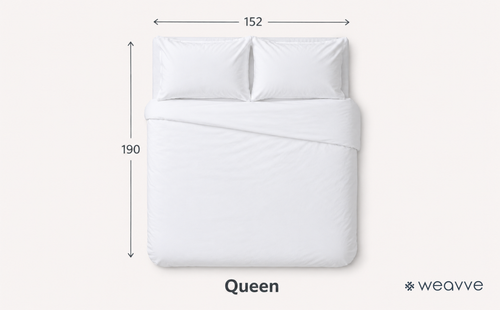
152 x 190 cm (60” x 75”) |
152 x 203 cm (60” x 80”) |
UK King: 150 x 200 cm |
153 x 203 cm (60” x 80”) |
|
King |
182 x 190 cm (72” x 75”) |
193 x 203 cm (76” x 80”) |
Super King: 180 x 200 cm |
183 x 203 cm |
Three things to notice:
A Singapore queen is 13 centimetres (about 5 inches) shorter than an American or Australian queen. That’s roughly the length of your hand. If you order sheets from an overseas marketplace, the fitted sheet’s foot end will pucker and the flat sheet will overhang awkwardly on one side.
What Singapore calls a “queen”, the UK roughly calls a “king”. Cross-shopping between regions without the conversion will get you the wrong size every time.

Featuring Weavve Home’s Queen Bed Sheets
Super single (107 x 190 cm) is a uniquely Southeast Asian size, common in HDB bedrooms, and has almost no direct equivalent abroad. International twin and twin XL sheets will not fit it.
The fix is simple but worth saying: when you’re shopping in Singapore, buy sheets sized for Singapore. Local bedding brands, including Weavve Home, build their sheets to 152 x 190 cm for the mattress itself, with extra length built into the fitted skirt to hug a deeper modern mattress.
How to Measure for a Queen Fitted Sheet (Without Guessing)
Width and length are only half the story. The detail most shoppers miss, and the reason many “correctly sized” sheets still don’t fit is pocket depth, the vertical drop of a fitted sheet from the top edge of the mattress to where the elastic gathers underneath.
A bare 2000s-style mattress was 20–25 cm thick. Today’s pillowtop, hybrid, latex, and memory-foam mattresses in Singapore routinely run 30–50 cm, and that’s before you add a topper. If your sheet’s pocket is shallower than your mattress, the corners will spring loose every time you roll over. If it’s too deep, the sheet will bunch and slide.

Featuring Weavve Home’s Signature TENCEL™ Classic Set
Use this quick decision tree:
Measure your mattress from the seam at the top to the seam at the bottom. Add the height of any topper. Add 2–5 cm for “wiggle room” so the elastic sits cleanly underneath. That number is your minimum pocket depth.
For most premium Singapore mattresses, a 35–40 cm pocket depth is the sweet spot. Anything labelled “deep pocket” usually means 35 cm+. A 40 cm / 16-inch pocket, which is what Weavve Home builds into every queen fitted sheet will comfortably fit a thick pillowtop plus a topper, with elastic to spare.
Best Sheet Material for Singapore’s Climate
The single most useful question you can ask before buying sheets in Singapore is: how will this material behave at 80% humidity, in a bedroom that’s either fully air-conditioned or fully not?
That filter eliminates half the marketing you’ll see online. Here’s how the major materials actually perform.
TENCEL™ Lyocell

Image From Freepik
Lyocell is a fibre spun from sustainably harvested wood pulp under the TENCEL™ brand. Two properties make it almost custom-built for Singapore: it absorbs roughly 50% more moisture than cotton, and that moisture migrates through the fibre to evaporate from the surface so the sheet feels cool against the skin even on a sticky night without air-con.
Lyocell also has naturally smoother fibres, which means a silky drape from the first wash (no breaking-in period), and it’s intrinsically hypoallergenic and bacteria-resistant because the structure doesn’t give moisture anywhere to sit.
The trade-off is that Lyocell is finer and slipperier than cotton, so it needs a gentle wash cycle and a lower dryer setting but it dries faster than cotton in our climate, which more than balances out.

Featuring Weavve Home’s Signature TENCEL™ Collection
If you’re not sure where to start, this is the material we’d recommend most Singapore sleepers begin with. Weavve Home’s Signature TENCEL™ Collection range uses an 80s yarn count Lyocell. The higher the yarn count (but not overly high because this usually means misleading marketing), the finer and softer the resulting fabric.
Cotton

Image By Azerbaijan_stockers From Freepik
Cotton is the classic bed linen fibre, but “100% cotton” tells you almost nothing on its own. Two variables actually decide how a cotton sheet feels and performs: the weave (percale vs sateen) and the fibre length (short-staple vs long-staple vs extra-long-staple).
Percale is a simple one-over-one-under plain weave. It feels crisp, matte, and breathable — closer to a freshly pressed dress shirt. It is the cotton weave that performs best in humidity, because the open structure lets air pass through. If you sleep without air-conditioning or rely on a ceiling fan, percale is the cotton you want.
Sateen uses a four-over-one weave that exposes more surface yarn, producing the silky lustre most people associate with luxury hotels. The trade-off is that the denser surface traps a little more heat. In a heavily air-conditioned condo bedroom, sateen feels fantastic. In an HDB bedroom on a non-AC night, you’ll notice it runs warmer than percale.

Featuring Weavve Home’s Cotton Bed Sheets
Then there’s fibre length. Long-staple and extra-long-staple cottons — Egyptian, Pima and Supima are the well-known names that produce smoother yarn with fewer protruding fibre ends. The result is a softer, stronger, longer-lasting sheet. Watch out, though: “Egyptian cotton” on a label is not a guarantee of quality.
The term refers to where the cotton was grown, not how it was spun. Look for explicit specifications: 100s yarn count, single-ply, extra-long-staple. Weavve Home’s Cotton Bed Sheets, for instance, uses 100s yarn count extra-long-staple cotton in a 600 thread count single-ply sateen, certified to OEKO-TEX Standard 100, meaning it has been tested free of harmful chemicals.
Linen

Image By Partystock From Freepik
Linen, woven from flax, is the most aggressively breathable bedding fibre in mainstream use. Where cotton absorbs moisture into the fibre core, linen wicks along the surface and evaporates almost immediately. It’s also durable enough to last decades.
The trade-off is the famously rumpled, textured hand-feel, which some people love, and others find too rough. For Singapore’s climate, the key spec is GSM (grams per square metre), not thread count. A 120–160 GSM linen is light and ultra-cool, ideal for non-AC sleepers. 180–220 GSM is the comfortable mid-range. Anything above 220 GSM is winter-weight and overkill here.
Bamboo Viscose

Image By Rawpixel.com From Freepik
Bamboo bedding occupies a strange marketing space. Most “bamboo” sheets are technically bamboo viscose, a regenerated cellulose fibre produced by chemically dissolving bamboo pulp and re-extruding it. The end product behaves more like rayon than like raw bamboo.
That’s not necessarily bad. Bamboo viscose can be genuinely soft, breathable and moisture-wicking. But two myths need correcting.
First, the cooling and antibacterial properties come from the weave and yarn structure, not from “natural bamboo magic”. Second, quality varies wildly between manufacturers. There’s no equivalent of “Supima” certification for bamboo, so you’re trusting the brand. If you like the feel, buy from a brand that publishes specs. If you don’t, TENCEL™ Lyocell offers the same cooling benefits with a more verifiable supply chain.
Silk and Microfibre

Image By Upklyak From Freepik
Silk is luxurious and hair-friendly, but it’s expensive, fragile, and the protein structure can trap heat in a humid climate. Reserve it for pillowcases if you love it. Microfibre is a cheap polyester. It feels fine in a guest bedroom, but it does not breathe in Singapore’s climate; moisture sits on the surface, which is the opposite of what you want.
Thread Count vs GSM vs Weave: What Actually Matters
If we could erase one number from the sheet marketing, it would be thread count. Here’s why.
Thread count measures the number of horizontal and vertical threads in one square inch of fabric. In theory, more threads mean a denser, smoother fabric. In practice, the math breaks down once you go past about 400. Manufacturers chasing big numbers started using multi-ply yarns by twisting two or three thinner threads together and counting each ply separately.
A “1,000 thread count” sheet is often a 250 thread count sheet with four-ply yarn, which is heavier, less breathable, and no softer than a proper 400 count single-ply.
A useful rule of thumb: 300–500 single-ply is the genuine premium range for cotton. Above that, treat the number with suspicion unless the brand explicitly states the ply count. Weavve Home, for example, publishes “600 thread count, single ply” rather than letting the number stand alone; that single-ply spec is what makes a high thread count actually meaningful.

Featuring Weavve Home’s Signature TENCEL™ Classic Set
For TENCEL™ Lyocell, ignore thread count entirely. Lyocell quality is described by yarn count (80s, 100s — higher is finer). For linen, ignore both and look at GSM.
Across all three fibres, the variable that matters more than any number is weave. Percale will outperform sateen for breathability regardless of thread count. A 150 GSM linen will out-cool a 220 GSM linen regardless of fibre origin. Buy the weave that suits your sleep environment first; treat thread count as a secondary check.
AC Sleeper or Non-AC Sleeper? Match Your Material to Your Bedroom
Here’s a simple framework. Two sleepers in Singapore can be in the same climate but have very different bedrooms.
If you sleep with the air-con on for most of the night, you can comfortably wear denser, more luxurious materials: sateen cotton, TENCEL™ Lyocell, or mid-weight linen. The room is doing the cooling work. Lean toward what feels best against your skin: silky, weighty, drapey.
If you sleep with a fan or open windows, prioritise breathability over silkiness: percale cotton, TENCEL™ Lyocell, or light-weight linen (120–160 GSM). The sheet itself needs to do the work of moving heat and moisture away from your body.
If you switch between the two (air-con on hot nights, fan on cooler ones), TENCEL™ Lyocell is the most forgiving choice. Its moisture regulation works in both directions: cooler when it’s humid, warm enough when the room is dry.

Image By Dit26978 From Freepik
How to Care for Queen Bed Sheets in a Tropical Climate
A surprising amount of sheet disappointment is actually care failure. Singapore’s humidity puts more demand on your laundry routine than temperate climates do, and a few simple changes will dramatically extend the life of your sheets.
-
Wash cool, not hot: 30°C is plenty for natural fibres. Hot water sets stains and accelerates fibre breakdown. Importantly, this doesn’t kill more germs than warm water if you’re using a decent detergent.
-
Skip fabric softener entirely: Softener works by coating the fibre with a waxy film. On a moisture-wicking fibre like TENCEL™ Lyocell or bamboo viscose, that film clogs the very channels that make the sheet feel cool. Use white vinegar in the rinse cycle instead if you want softness.
-
Dry promptly: Damp sheets sitting in the machine in 85% humidity grow mildew startlingly fast. If you line-dry, do it inside out and in shade, direct sun fades dyes. If you tumble-dry, use medium heat for cotton and low heat for TENCEL™ Lyocell or linen.
-
Rotate two sets: Bed sheets last roughly twice as long if you alternate between two sets rather than washing and re-using the same one. It also means you always have a clean spare for the inevitable rainy-day laundry crisis.
- How often to wash? Once a week is the standard recommendation for sheets and pillowcases. In Singapore’s climate, where night sweat is heavier, every five to seven days is the realistic answer for most people.
How Much Should You Spend on Queen Bed Sheets in Singapore?
There are three rough price tiers worth knowing.
Below S$80 per queen set. Mostly polyester blends, microfibre, or low-grade cotton imported in bulk. Fine for a guest room or a short-term rental, but they won’t breathe well, and they tend to pill within months.
S$80–S$200 per queen set. The honest mid-market. You can find decent 300–400 thread count single-ply cotton, basic TENCEL™ blends, and entry-level Singapore brand sets here. Look carefully at specifications. This is the tier where marketing language is most likely to outrun reality.
S$200–S$500+ per queen set. Premium territory: extra-long-staple cotton at 600+ single-ply thread count, full Lyocell sets, or pure linen. Built to last five to ten years with proper care, which works out to less per night than the cheaper tier replaced annually.

Featuring Weavve Home’s Signature TENCEL™ Deluxe Set
Weavve Home’s Signature TENCEL™ Classic Set sits in this range, with the Signature TENCEL™ Deluxe Set (which adds two extra pillowcases and two bolster cases) priced higher to reflect the larger inclusion.
When you compare quotes, normalise the price by what’s in the set. A “set” can mean fitted + duvet cover + two pillowcases, or fitted + flat + four pillowcases + two bolster cases. The cheaper set is rarely the better value once you’ve added the missing pieces.
Frequently Asked Questions
What are the exact dimensions of queen bed sheets in Singapore?
Singapore queen mattresses are 152 x 190 cm (60” x 75”). A fitted sheet sized for this market will list those dimensions plus a pocket depth: 35 to 40 cm is standard for premium brands. A queen duvet cover is typically 210 x 210 cm, and a queen flat sheet is around 245 x 270 cm.
How often should I change my bed sheets in Singapore?
Every 5 to 7 days, given local humidity and nighttime perspiration. Pillowcases benefit from being swapped a little more often if you have sensitive skin.
Do I need a fitted sheet, a flat sheet, or both?
A fitted sheet is non-negotiable. It’s what protects the mattress. The flat sheet is optional and largely a personal preference. In Singapore, many sets are duvet-cover-based rather than flat-sheet-based, which means the duvet cover replaces the flat sheet’s protective role. If you sleep without a duvet, a flat sheet on its own is a comfortable, breathable layer.
Is hotel-quality bedding really achievable at home?
Yes, and usually without spending hotel-supply prices. Hotels overwhelmingly use percale or sateen cotton at 300–400 thread count, in extra-long-staple varieties, washed in industrial volumes with strong detergent and high heat.
The “hotel feel” is mostly about crispness on day one. At home, a 600 thread count single-ply sateen cotton in extra-long-staple fibre will feel softer than most hotel sheets while still being crisp.
TENCEL™ vs Cotton: Which is actually better?
Neither is universally better. TENCEL™ Lyocell wins on moisture management, cooling, and hypoallergenic properties, and feels silky from day one. Extra-long-staple cotton wins on familiar hand-feel, gets softer with every wash, and is slightly more forgiving in the laundry.
In Singapore’s climate, TENCEL™ is the more climate-appropriate default; cotton remains a wonderful choice if you prefer its texture. Many homes keep both and rotate seasonally or rather, between rainy and drier weeks.
Are bamboo sheets worth it in Singapore?
They can be, but with a caveat. Most “bamboo” sheets are bamboo viscose, a regenerated rayon fibre. Quality is highly manufacturer-dependent. If you’re drawn to bamboo for environmental or cooling reasons, TENCEL™ Lyocell achieves similar (often better) results with a more transparent production process.
Where should I buy queen bed sheets in Singapore?
If you’re looking for queen bed sheets in Singapore, Weavve Home offers queen-sized bedding designed for local mattress dimensions, with deep fitted sheets made to fit modern mattresses comfortably.
Beyond queen bed sheets, we also carry a full range of bedding sizes, including Single, Super Single, King, and Super King, making it easier to find the right fit for every bed in your home. You can choose from breathable TENCEL™ Lyocell and cotton collections, depending on your preferred sleep feel.
The Short Version
If you remember nothing else from this guide:
A Singapore queen is 152 x 190 cm, not the same as a US, UK or Australian queen. Buy sheets sized for Singapore.
Match the material to your bedroom, not to the marketing. TENCEL™ Lyocell for humidity first sleeping, percale cotton for non-AC nights, sateen cotton for fully air-conditioned rooms, linen if you love the texture.
Treat thread count as a single data point, not the whole story. Above 400, ask whether it’s single ply.
Check pocket depth. 35 to 40 cm covers most modern Singapore mattresses, including pillowtops with a topper.
And finally, care matters. Wash cool, skip the softener, dry promptly, and rotate two sets. The right sheets, looked after well, will outlast three rounds of cheaper ones.
Sleep well.
This buyer’s guide is brought to you by Weavve Home, a Singapore home brand specialising in TENCEL™ Lyocell and extra-long staple cotton bedlinen designed for the local climate. Every Weavve Home queen sheet is built to Singapore mattress dimensions with a 40 cm deep pocket, and our sets include bolster cases as standard.
Browse the Bedlinen Collection to see what’s in stock.